Hot Topics:

Target Keyword: High-ticket vs low-ticket affiliate marketing Meta Description: Discover the key differences between high-ticket and low-ticket affiliate marketing. Learn which model is best for beginners in 2026, including profitability breakdowns and required tools.
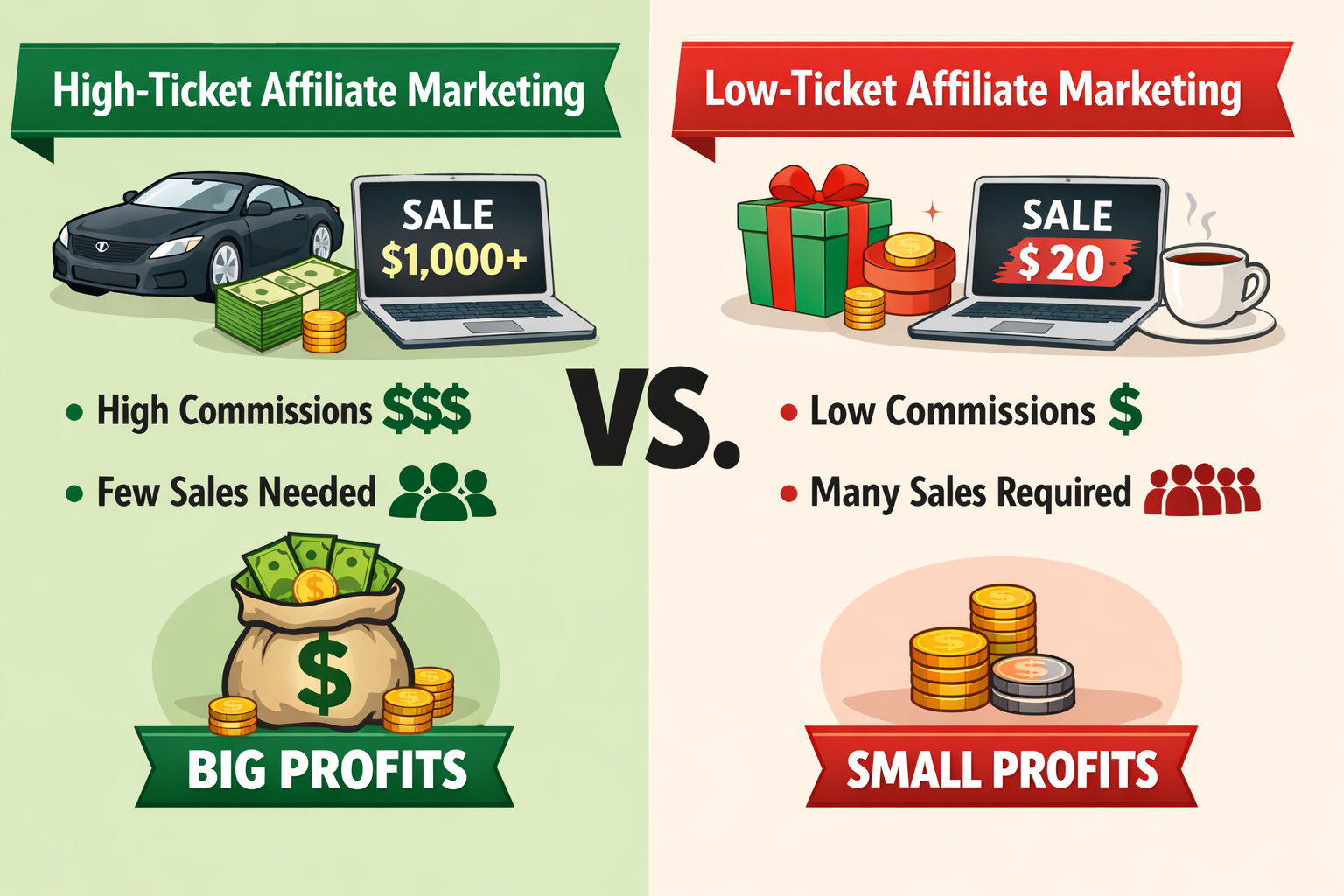
Affiliate marketing has become a multi-billion-dollar business thanks to the digital economy. It gives business owners a way to make money without having to do anything. Choosing your ticket size is the most important decision you will make for your business model. It will affect your whole strategy, workload, and possible return on investment. It’s not just the price of the product that makes high-ticket and low-ticket affiliate marketing different. It changes the way you get traffic, build trust, and set up your sales funnels in a big way.
If you pick the wrong ticket size for your skill level and budget, you could get really burned out and waste a lot of money on ads. You will probably lose money if you rely on paid ads for products with low margins. On the other hand, if you try to sell high-end coaching packages without a proper trust-building sequence, your conversion rates will drop to zero. The first step to starting a successful online business is to learn the ins and outs of both models.
What is Low-Ticket Affiliate Marketing?
Low-ticket affiliate marketing is all about promoting goods and services that cost little to buy, usually between $1 and $100. These items are great for impulse buys because the buyer doesn’t have to spend much money on them. People don’t need to talk to their spouses, check their budgets, or watch a 60-minute webinar to decide whether they want to buy a $20 phone case or a $15 e-book.
Commissions for physical goods usually range from 1% to 10%, but for digital goods with low prices, they can be as high as 50%. Even though the percentage is high, the actual dollar amount made on each sale is still low, usually between $0.50 and $20. The Amazon Associates program is the most well-known place for this. It sells everything from kitchen gadgets to electronics.
The Mechanics of Volume
You need to know how volume works in order to do well in the low-ticket space.Volume-based marketing is a way to make money by doing a lot of small transactions instead of a few big ones.
- Simple Explanation: If you want to make a full-time income from cheap products, you need thousands of people clicking your links every single day.
- Detailed Explanation: Let’s say your goal is to make $5,000 a month. You need to get 1,000 people to buy a product that pays you $5 for each sale if you want to promote it. If your website’s conversion rate is 2%, you will need exactly 50,000 highly targeted visitors every month just to meet that standard. This calls for an aggressive and never-ending approach to making content, optimizing it for search engines (SEO), or getting it to go viral on social media.
Pros and Cons of the Low-Ticket Model
Starting with low-ticket offers provides several distinct advantages, particularly for absolute beginners who are learning the ropes of digital marketing. However, the model carries significant drawbacks that can hinder long-term growth.
The Pros:
- Lower Barrier to Entry: When a product costs USD 15, the consumer’s perceived risk is incredibly low, making it easier to secure a sale without advanced persuasion skills.
- Faster Feedback Loop: Because it is easier to generate sales, beginners receive positive reinforcement and conversion data much faster.
- Established Brand Trust: Promoting mega-brands like Target or Amazon means you do not have to convince the buyer that the retailer is trustworthy.
The Cons:
- Massive Traffic Requirements: You need an enormous audience to make a livable income, which can take years of consistent, unpaid labor to build organically.
- Incompatible with Paid Ads: Thin margins make it mathematically impossible to use paid advertising. Spending USD 10 to acquire a customer who yields a USD 4 commission will quickly bankrupt your business.
- Platform Vulnerability: Affiliate programs for physical goods frequently slash their commission rates without warning, making your income fragile.
What is High-Ticket Affiliate Marketing?
High-ticket affiliate marketing is when you promote high-value, expensive goods and services. Most of the time, these things cost around $500, but they can easily go up to $10,000 or more. This model calls for a big change in how we think about marketing, from trying to appeal to everyone to focusing on generating highly targeted, high-intent leads.
High-ticket items aren’t just pricey; they change your life. Buyers are paying for a huge return on investment, a big change in their lives, or business solutions that are only available to them. Some of the most profitable niches are B2B software (SaaS) with high monthly retainers, exclusive mastermind groups, high-end wealth management courses, and specialized health protocols.
The Power of Premium Commissions
The most important thing about high-ticket affiliate marketing is how powerful one conversion can be. Affiliates don’t chase pennies; instead, they get big, life-changing payments from each buyer. Digital high-ticket items usually pay between 30% and 50% in commissions.
If you sell a specialized business coaching program for $4,000 and get a 40% commission, you’ll make $1,600 right away. This changes the math for your business in a big way. Instead of trying to get millions of page views, your focus changes to finding a small number of very qualified leads.
Pros and Cons of the High-Ticket Model
For those willing to master advanced marketing skills, high-ticket affiliate marketing offers unparalleled scalability. Yet, it is entirely unforgiving to marketers who lack patience or technical skill.
The Pros:
- Higher ROI per Sale: Because your payout per conversion is massive, you can comfortably afford to spend money on advertising and still walk away with a high net profit.
- Quality Over Quantity: An email list of 500 highly targeted, wealthy professionals can generate more revenue than a social media account with 100,000 casual followers.
- Relationship-Based Selling: By positioning yourself as an expert in a specific niche, you build a loyal audience that will repeatedly purchase premium recommendations from you.
The Cons:
- Longer Sales Cycles: Nobody impulse-buys a USD 5,000 software suite. A prospect might discover your content in January and finally make a purchase in April.
- Advanced Skill Requirements: You must understand how to build lead magnets, write persuasive automated email sequences, and utilize advanced sales funnels.
- Higher Audience Skepticism: When asking consumers to part with thousands of dollars, you must provide overwhelming proof, case studies, and guarantees to secure the sale.
Key Differences: Traffic vs. Trust
The main difference between the two models is the fight between Trust and Traffic.
When it comes to low-ticket affiliate marketing, it’s all about traffic. The relationship with the buyer is only for a short time and is based on a transaction. They look for a product, click on your article, buy it on Amazon, and probably forget the name of your website. You live off of SEO and the huge amount of traffic that comes through.
Affiliate marketing for high-ticket items is a game of trust. The quality of the relationship is much more important than the amount of traffic. For someone to buy a high-end product, they need to see you as an expert in your field. You need to take care of them, teach them, and help them through a complicated buying process.
Profitability Analysis: A Comparative Example
To clearly illustrate the mathematical differences, let us examine a comparative breakdown. Assume an affiliate marketer has a strict monthly revenue goal of USD 10,000.
| Metric | Low-Ticket Approach | High-Ticket Approach |
|---|---|---|
| Product Price | USD 40 | USD 3,000 |
| Commission Rate | 5% (USD 2 per sale) | 40% (USD 1,200 per sale) |
| Sales Required for USD 10k | 5,000 Sales | 9 Sales |
| Assumed Conversion Rate | 3% | 0.5% |
| Traffic Required Monthly | 166,666 Visitors | 1,800 Visitors |
| Viability of Paid Ads | Impossible (Negative ROI) | Highly Effective |
As the table demonstrates, generating nearly 170,000 monthly visitors requires massive organic infrastructure. Conversely, finding 1,800 targeted leads can be achieved relatively quickly with optimized advertising.
The “Value Ladder” Strategy
You do not necessarily have to choose just one path. The most successful affiliate marketers in the world utilize a concept known as the Value Ladder. This strategy blends the psychological ease of low-ticket with the profitability of high-ticket.
- Simple Explanation: You start by offering something cheap to get people in the door, and then slowly offer them more expensive things over time as they trust you more.
- Detailed Explanation: A value ladder uses a low-cost product, like a front-end liquidator, to get customers and pay for advertising. You might, for instance, run an ad for a digital guide that costs USD 7. Once someone buys it, they will be added to your email list for premium buyers. You give them a lot of free value over the next six months while slowly introducing them to a high-ticket course that costs $2,000. The first $7 you spend goes toward your ads, so the high-ticket commissions you get later are all profit.
Technological Requirements
Depending on the size of the ticket you choose, the tools needed to carry out these plans can be very different.
The technology stack for low-ticket marketing isn’t too complicated. You mostly need a fast, SEO-friendly Content Management System (like WordPress), tools for finding keywords (like Ahrefs or SEMrush), and social media profiles that are active. The only thing that matters is getting content out there and making it easy to find.
You need to create an automated sales ecosystem if you want to market high-priced items. You will need funnel-building software (like ClickFunnels or Systeme.io), a strong Customer Relationship Management (CRM) tool, and automated email autoresponders (like ActiveCampaign). The technical barrier to entry is much higher, and you need to put in more money up front.
Which Model Should Beginners Choose in 2026?
Artificial intelligence (AI) and short-form video algorithms have a big impact on the digital world in 2026. Your money and time will determine which choice is “better.”
If you don’t have any money but a lot of time, start with low-cost marketing. Use sites like TikTok, YouTube Shorts, and a simple WordPress blog to get free traffic to cheap items. It is a great place to learn copywriting, video editing, and audience analytics without putting your money at risk.
If you have a starting budget of $1,000 to $3,000 and want to grow your business faster, high-ticket is the best way to go. Put your money into funnel software and paid ads. Learn how to make a great lead magnet, get people to sign up for your email list, and sell high-end affiliate products to a small, loyal group of people to protect yourself from changes in organic algorithms.
Conclusion
Both high-ticket and low-ticket affiliate marketing can work as business models, but they need very different ways of thinking. Low-ticket marketing is like having a huge digital billboard on a busy highway; it needs a lot of traffic and constant visibility. High-ticket marketing is like throwing an exclusive, fancy dinner party. You need to be close to your guests, be in charge, and know exactly who to target. You can build a strong and very profitable affiliate marketing business by knowing your strengths, figuring out your budget, and learning how to use the specific mechanics of the ticket size you choose.
Summary of Key Points
- Low-Ticket Mechanics: Products under USD 100 require massive traffic volume and rely heavily on organic SEO and social media reach.
- High-Ticket Mechanics: Products over USD 500 require advanced sales funnels, email nurturing, and relationship-building to overcome buyer friction.
- Advertising Viability: High-ticket commissions allow for profitable paid advertising campaigns, whereas low-ticket commissions do not provide enough margin.
- The Value Ladder: The most profitable businesses utilize both models, using low-ticket offers to acquire leads and high-ticket offers to generate substantial profit.
- Beginner Strategy: Choose low-ticket to learn the basics for free via organic content, or choose high-ticket if you have capital to invest in paid ads and funnel software.
Frequently Asked Questions
1.Can I upgrade my hosting plan later?
Absolutely. All the beginner hosts I recommend allow you to seamlessly upgrade from a basic shared plan to a more powerful plan with a single click as your website traffic grows.
2.Do I have to buy my domain and hosting from the same company?
No, you do not. However, keeping them together is usually much easier for beginners, as it removes the technical step of pointing DNS records from a third-party domain registrar to your new host.
3.Is free hosting worth it for a beginner?
I strongly advise against completely free hosting. They typically force you to display their ads on your site, offer terrible server speeds, provide zero customer support, and can delete your website without warning. Paying USD 1.00 to USD 3.00 a month is a small price for total control and reliability.
4.Is WordPress the right choice for beginners?
For many beginners, WordPress offers a friendly balance of ease-of-use and extensibility. If you want the simplest path, start with a host that offers one-click WordPress.
5.What is the best hosting for absolute beginners in 2026?
I recommend starting with Hostinger for balance or IONOS for ultra-low entry pricing, then reassessing after a few months as your site grows.